
The Mystery of the Vanished Citations
James McConnell’s Forgotten 1960s Quest for Planarian Learning,
a Biochemical Engram, & Celebrity
by Mark Rilling
The Missing 1960s Decade
Memory transfer: McConnell’s Blind Alley
McConnell’s Struggle With Critics Over Invertebrate Learning
Controlling for Experimenter Bias
Controlling for Pseudoconditioning & Sensitization
McConnell’s Origin Myth for Planarian Learning
Escaping peer review as a celebrity-scientist
The Worm Runner’s Digest: Peer Review Versus the 1960s Counterculture
Attracting the Unabomber. While overselling behavior modification
The Assassination Attempt
Overpopularizing Behavior Modification
Conclusion: Some Historical Lessons for Today from the 1960s
References
In addition to the serious science, the Digest was clearly part of a counterculture effort to poke fun at the scientific establishment. The masthead of each volume of the Digest included a shield with a two-headed planarian, below which was a Latin inscription Ignotum per Ignotius, translated humorously as the unknown explained through the still more unknown. The problem was that as the head of the Planarian Research Laboratory at one of the finest research institutions ever assembled and as a scientist whose research grants were subsidizing the Digest, McConnell (1961 b) was attacking himself because he was part of the scientific establishment. The scientists who published the serious articles in the Digest wanted to receive credit from others for their work. Citation by others is one of the clearest ways of providing credit. One issue that surfaced early was

Does one dare cite an article from The Worm Runner’s Digest?
in a peer-reviewed journal. For some editors, the answer was clearly no. McConnell was never able to achieve a satisfactory resolution between his sense of humor and his sense of science. McConnell’s first solution was to put the serious articles at the beginning of the journal and the satire at the end. When the serious authors of the scientific articles complained that abstracting services refused to consider citation for any article that appeared in a journal with such a strange title as The Worm Runner’s Digest, McConnell twinned the journal. The front half was called The Journal of Biological Psychology1, but the back half, which was published upside down, was The Worm Runner’s Digest. Suddenly, libraries wanted to subscribe to The Journal of Biological Psychology, and Psychological Abstracts requested a copy of this new journal for abstracting (McConnell, 1969). By 1967, McConnell announced a policy of peer review for both journals; thus, even McConnell was forced to adopt a policy of peer review. McConnell poured thousands of dollars over the years from his own pocket to keep the Digest alive, so the journal represented a financial loss for him. In his closing editorial, he recognized that
it is impossible to publish a journal these days without the backing of some organization
McConnell was a precursor of the neuroscientists who took up the biochemistry of memory where he left off. McConnell only got inside his organism with biochemical rhetoric, never with a valid neurophysiological technique. Today planaria are no longer used in research in the biochemistry of learning, so McConnell’s planarian learning program represents the end of a line.
However, the torch of the search for the engram was passed to the next generation. The location of the books in the library at Michigan State University provides a metaphor for this historical transition. The Worm Runner’s Digest was passed to history when it ceased publication in 1979. In this library, a few feet away from the last volume of the Digest, is the first volume of The Journal of Neuroscience,
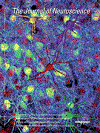 The Journal of Neuroscience is a weekly peer-reviewed scientific journal published by the Society for Neuroscience.
which began publication in 1981. No one could ever confuse The Journal of Neuroscience with a humor magazine. That journal was published by the Society for Neuroscience, and in its first volume there was an article on classical conditioning of a simple withdrawal reflex in the invertebrate, Aplysia californica, by Carew, Waiters, and Kandel (1981). After a quarter of a century, this article is a worthy successor to Thompson and McConneU’s (1955) first article on planarian classical conditioning. There is no reference to McConnell or the controversy over planarian learning, but Carew et al. followed in McConnell’s footsteps with the following procedures: visual observation of the dependent variable; five control groups, each of which had been used earlier in invertebrate learning; and the testing, which was carried out using a blind procedure. The lessons from the planarian controversy had been mastered by those who were about to write the next chapter in the search for the engram by watching siphons withdraw instead of planaria turn. With settlement of the invertebrate learning controversy by the specification of control groups, McConnell liberated the next generation. The dream of a Nobel prize for unraveling the biochemistry of memory now belongs to a new group.
1 There are no issues in the electronic archive before 2013.
5 Behavior Management Resources for Teachers
by Janelle Cox
Turn-a-Card Behavior Management Plan

There are numerous variations of the Turn-A-Card method, the most popular being the Traffic Light behavior system. This strategy uses the three colors of the traffic light with each color representing a specific meaning. This method is usually used in preschool and primary grades. The following Turn-A-Card plan is similar to the traffic light method but can be used throughout all elementary grades.
Introducing Your Class Rules

The following article will give you a few tips on how to introduce your class rules, and why it’s best to only have a few. Plus, you will get a sample generic list in addition to a specific list of class rules to use in your room.
Tips on Handling Difficult Students

Effective teachers choose discipline techniques that will encourage positive behavior and motivate students to feel good about themselves and the decisions that they make. Use the following five tips to help you combat classroom disruptions, and deal with those difficult students.
Behavior Management and School Discipline

This article will teach you how to strategize, get inspired, and write your classroom rules. As well as organize your classroom for maximum learning, communicate your discipline program to your students’ parents, and help you learn how to get the parental support you need.
