
by David Weinberg

It’s like they’re always watching you. He gestures to windows in the roof of his cell where guards can observe him. Or they’re listening to you. He indicates the speaker on the wall. Always judging how you’re behaving. Always telling you … his voice trails off.
He looks at the floor in his cell thinking of what else to say. It is dinner hour at the prison, and a cart staffed by ten men begins moving slowly down the wing. One of the servers silently gestures to the prisoner with an antiseptic, plastic — gloved hand. All but one of the prisoners accept the stew and boiled potatoes served through a rectangular slot in the cell’s bars.
The prisoner continues, placing his food aside momentarily.
One thing you don’t realize about the place is once you’re in, you’re in for good. There’s no way out of here except through the program.
It’s not the type of thing they’re talking about at cocktail parties anymore.
It had its fling int the newspapers. For a while it triggered the public’s imagination. Then behavior modification
Behavior modification is an early approach that used respondent and operant conditioning to change behavior.
went the way of most vogue topics in this country — fading like the ephemeral image on a television screen.
For an involved few, it is a topic that has never lost its impact on society. To some its an unbeatable method of personal problem solving. For others it symbolizes psychogenocide — the ultimate control of human behavior.
In the deepening silence surrounding it, behavior modification has moved quietly into the prison system. schools and one-on-one therapy. The initial furor has dissipated, but the dehavior modification story and its problem remain — harbringers of a new technology and a new age.
Local behaviorist James McConnell once said to a group of lawyers that
The day has come when we can combine sensory deprivation with the use of drugs, hypnosis and the astute manipulation of reward and punishment to gain almost absolute control over an individual’s behavior … I forsee the day when we could take the worst criminal and convert him into a decent respectable citizen in a matter of months — or even less time than that.
McConnell said earlier this year that this statement was
blown totally out of proposition. The fact was, I was talking to a group of lawyerswho were doubting that people could ever be changed. I wanted to reassure them that prisoners could be changtd as people.
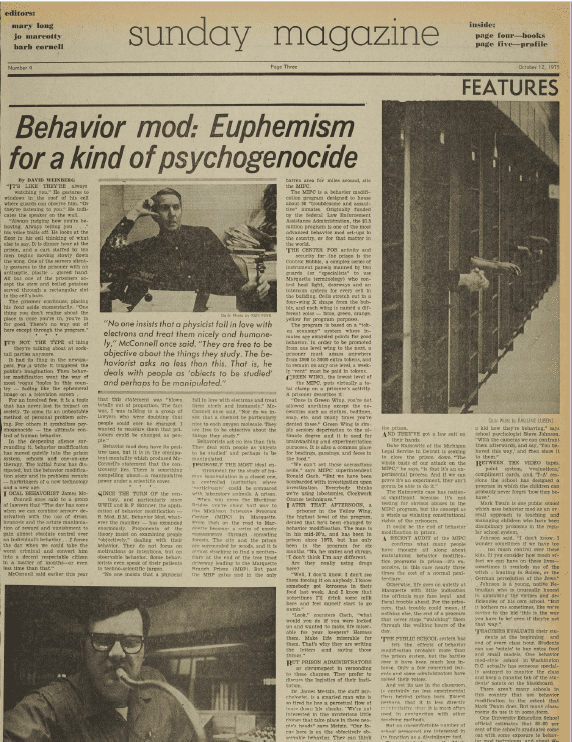
No one insists that a physicist fall in love with electrons and treat them nicely and humanely. McConnell said. They are free to be objective about the things they study. The behaviorist ask no less than this. That is, he deals with people as objects to be studied and perhaps to be manipulated.
Behavior mod does have positive uses, but it is in the omnipotent mentality which produced McConnell’s statement that the controversy lies. There is something compelling about — a manipulative power under a scientific cover.
Since the turn of the century, and particularly since WWII and B. F. Skinner, the application of behavior modification — B.Mod, B.M., Behavior Mod, whatever the moniker — has expanded enormously. Proponents of the theory insist on examining ptople objectively, dealing with their behavior. They do not focus on motivations or intentions, but on observable behavior. Some behaviorists even speak of their patients in techno-scientific jargon.
No one insists that a physicist fall in love with electrons and treat them nicely and humanely McConnell once said. Nor do we insist that a chemist be particularly nice to each oxygen molecule. They are free to be objective about the things they study.
Behaviorists ask no less than this. They deal with people as objects to be studied and perhaps to be manipulated.
Probably the most ideal environment for the study of human manipulation is a closed one, a controlled institution where participants could be compared with laboratory animals. A prison.
When you cross the Mackinac Bridge,

The Mackinac Bridge is a suspension bridge spanning the Straits of Mackinac, connecting the Upper and Lower peninsulas of the U.S. state of Michigan.
you’re about half way to the Michigan Intensive Program Center (MIPC) in Marquette.

Marquette University is a private Jesuit research university in Milwaukee, Wisconsin
From then on the road to Marquette becomes a series of empty passageways through sprawling forests. The city and the prison are surrounded by woods, and it is almost shocking to find a penitentiary at the end of the tree lined driveway leading to the Marquette Branch Prison (MBP).
The Marquette Branch Prison is located in Marquette, Michigan on the south shore of Lake Superior.
But past the MBP gates and in the only barren area for miles around, sits the MIPC.
Kathleen Stein. King of Worm Runners
By sandwiching the linear information between two slices of Gestalt, McConnell appeals to both sides of the brain — the no-nonsense left hemisphere and the poetic shape maker on the right. It works like behavior mod, says McConnell, a tall, fortyish man with a sort of wide-angle, bigger-than-life face. One might encounter this visage close-up in a Stanley Kubrick movie offering you a smoking glass of ye olde ultragiggle.
Behavior mod outlines the pattern for you, arranges the material so that your rignt hemisphere perceives, while your left learns by rote. That’s what my stories are supposed to do: help the right perceive patterns and become emotionally involved while presenting the material in a form easily memorized by the left.
the hostility of the gray birds in the groves of academe against this bird with the too-hilarious voice.
I hope so, the psychologist says with an air of elegant melancholia that often hangs like a little cloud over the head of our best humorists.
But, I remind you, most people with political power don’t have a good sense of humor – in any field. New endeavors need humor, because you’re trying to unify a group; you’re fighting for you existence, or fighting an establishment. Humor doesn’t go over well; humor has too much intellect in it.
The flatworm, or planarian, sometimes described as a gliding patch of slimy skin, is a fabulous creature able to divide into scores of pieces, each of which regenerates into a new worm. As the lowest organism on the phylogenic scale, it has a primitive brain and synaptic nervous system. Planaria present an elemental model on which to study learning and memory.
The two young worm runners’ results, indicating that planarians can be taught to scrunch up on cue, made no waves, McConnell went on to teach at the University of Michigan, where he took the experiment one scrunch further. He cut the worms in half, and when the tail halves had regenerated, they remembered a such about how to behave in the spotlight as the head did, and sometimes more.
If I had to do it over, I would have qualified all my statement with ‘ifs’ and ‘perhapses’ appeared dead serious, and never smiled at anything. And I would have gone mad.
Then we chopped them up and fed the pieces to untrained cannibalistic planarians. We also fed untrained victims to a control group. After we had given both groups a couple of days to digest their meal, we trained both groups. To our delight, the planarians that had eaten educated victims responded more often than did the worms that had consumed their untrained brethren. We seemed to have transferred a memory engram from one animal to another!

