
by Ruth Littmann, Daily Staff Writer
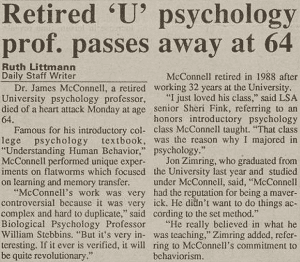
Dr. James McConnell, a retired University psychology professor, died of a heart attack Monday at age 64.
Famous for his introductory college psychology textbook, Understanding Human Behavior, McConnell performed unique experiments on flatworms which focused on learning and memory transfer.

McConnell’s work was very controversial because it was very complex and hard to duplicate, said Biological Psychology Professor William Stebbins. But it’s very interesting. If it ever is verified, it will be quite revolutionary.
McConnell retired in 1988 after working after 32 years at the University.
I just loved his class said LSA senior Sheri Fink,
 Sheri Fink is an American journalist who writes about health, medicine and science.
referring to an honors introductory psychology class McConnell taught. But That class wsa the reason why I majored in psychology.
Jon Zimring, who graduated from the University last year and studied under McConnell, said,
McConnell had the reputation for being a maverick. He didn’t want to do things according to the set mrthod.
He really believed in what he was teaching, Zimring added, referring to McConnell’s commitment to behaviorism.
James McConnell. Worm Runner’s Digest
Продолжение Назад
Work with flatworms has led worm runners to a particular worldoutlook, as well as particular personality traits, which may be manifested in various ways. For instance, with a mixture of rue and distaste, Dr. McConnell writes that
today, Science stands fair to join Religion, Motherhood and the Flag as a domain so sacrosanct and so sanctomonious, that leg-pulling isn’t allowed, levity is forbidden, and smiling is scowled at.
But, because tradition and over-weening sobriety are two very real enemies of the creative mind, no one who plays with worms for a living, as he and his students and co-workers do,
could survive the jibes of his colleagues unless armored by a penetrating insight into the cosmic comicness of this whole affair called science.
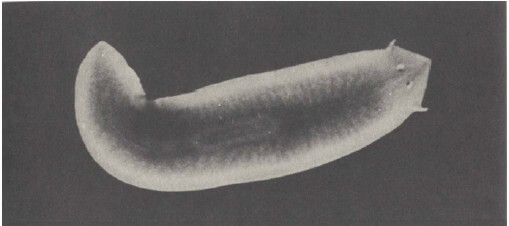
The flatworm used in the research group’s work have a disconcertingly humanoid, cross-eyed appearance, and are about half an inch in length when fully grown.
The fascination of these animals derives from the fact that they are the lowest creatures in the evolutionary hierarchy who possess a brain of sorts and a true central nervous system, with bilateral symmetry, but at the same time the highest ranking among organisms which reproduce by fission
Arthur Koestler, A New Look at The Mind, London Observer, April 30, 1965.
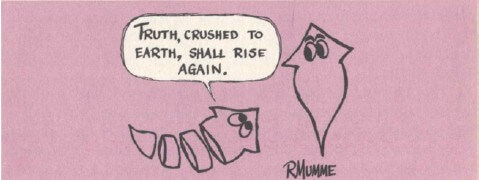
They may drop their tails at one season; the head section grows a new tail, the old tail grows a new head. They can be sliced into as many as six segments, each of which will regenerate into complete planarians.
But, planarians are multi-talented. Hermaphrodites, they function as males in their youth, but in maturity decide they will propagate the race as females, and lay eggs.
At one stage in its life-cycle, usually during the mating season, the planarian becomes a cannibal and devours everything it can grab, including its own discarded tail, which has been in the process of growing a new head.
The name of the journal, The Worm Runner’s Digest, seems an appropriate pun in the light of both natural cannibalism and the cannibalism experiments on transfer of learning.
There have been through the years many facets to the Digest. In Vol. I, No.1, the November, 1959 issue, is a sober and scientific article on the apparatus needed to house, transport, and experiment with planarians. And there is another treatise on the experimental procedures to be followed in working with planarians; this article includes a complete data sheet for recording experimental results. Another perfectly straightforward paper appears, The Feeding and Care of Planaria. Somehow, everything is not as cut and dried as it at first seems. The paper, written by Margaret Clay of the Planarian Research Group, concludes:
But, planarians are multi-talented. Hermaphrodites, they function as males in their youth, but in maturity decide they will propagate the race as females, and lay eggs.
At one stage in its life-cycle, usually during the mating season, the planarian becomes a cannibal and devours everything it can grab, including its own discarded tail, which has been in the process of growing a new head.
The name of the journal, The Worm Runner’s Digest, seems an appropriate pun in the light of both natural cannibalism and the cannibalism experiments on transfer of learning.
There have been through the years many facets to the Digest. In Vol. I, No.1, the November, 1959 issue, is a sober and scientific article on the apparatus needed to house, transport, and experiment with planarians. And there is another treatise on the experimental procedures to be followed in working with planarians; this article includes a complete data sheet for recording experimental results. Another perfectly straightforward paper appears, The Feeding and Care of Planaria. Somehow, everything is not as cut and dried as it at first seems. The paper, written by Margaret Clay of the Planarian Research Group, concludes:
If you follow these directions and everything dies, try again, using your own common sense variations. It took Mother Nature thousands of years to really get living things growing successfully, you know, and even with her help, it may take you a few weeks to catch on.
Not all the articles concern worm-running. In another issue, Vol. VII, No.1, is a profound paper, written by Lawrence A. Newberry of Purdue University. Mr. Newberry addresses himself to the problems of the effect of background noise on the detection of the cork-popping effect by popped-cork retrievers. Notwithstanding his attempt, Mr. Newberry makes only a single major contribution to the literature of science in an asterisked footnote on the first page of the paper.
Whenever you do not wish to show the extent of your ignorance on a particular subject, always say that it is beyond the scope of your paper. It works.
Learned theses analyze in detail research problems of particular investigators. One particularly valuable report was in a paper presented by four young people, Joan M. Klein, K. Suzanne Lathrop, Elizabeth J. Lominska, and Lesley E. Seaman. This study deals with the abstruse problem: The Effect of a Pre-Frontal Lobotomy on the Tsetse Fly. The researchers submitted that they had lobotomized some 3000 Congolese red-eyed thyroidectomized tsetse flies, divided into groups of 1500 males and 1500 females. Great care was taken to supply the reader with all pertinent information:

