
by Cal Samra
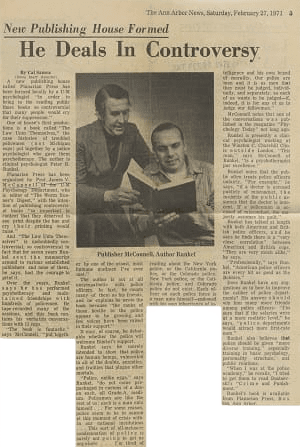
A new publishing house called Planarian Press has been formed locally by a U-M psychologist in order to bring to the reading public those books so controversial that many people would cry for their suppression.
One of house’s first production is a book called The Law Unto Themselves, the case histories of troubled policemen (not Michigan cops) put together by a police psychologist who gave them psycotherapy. The author is clinical psychologist Peter R. Runkel.
Planarian Press has been organized by Prof. James V. McConnell of the U-M Psychology department, who is editor of The editor The Worm Runner’s Digest, with the intention of publishingcontroversial book so important in content that they deserved to see print despite the hue and cry their printing would raise.
And The Law Unto Themselves is undoubtedly controversial, so controversial in fact that the for seven years Runkel sent the manuscript around to various established publishers and none of them, he says, had the courage to print it.
Over the years, Runkel says he has performed psychotherapy and maintained friendships with hundred of policemen. He tape-recorded many of the sessions, and this book contaisignn his verbatim conversations with 11 cops.

The book is fantastic, says McConnell, put together by one of the wisest, most humane madmen I’ve ever met.
The author is not at all unsympatetic with police officers. In fact, he counts many of them as his friends, and he explains he wrote the book because the ranks of those hostile to the police appear to be growing, and few voices have been raised in their support.
It may, of course, debatable whether the police will welcome Runkel’s support.
Runkel says he merely intended to show that police are human begins, vulytrable to all of the doubts, anxieties, and frailities that plague other mortals.
Police, unlike eggs, says Runkel,
do not come prepackaged in cartons a dozen each, all Grade-A, medium. Policemen are like the rest of us;each is a man unto himself … For some reason, police seem to be in season at this moment of crisis within our national institutions … This sort of all-inclusive condemnation of police is surely not going to get us anywhere … I’m tired of reading about the New York police, or the California police, and Colorado police do not exist. Each officer on each police force is a man unto himself — endowes with his own inheritance of intelligence and his own brand of morality. Our police are men and it is as men that they must be judged, individually, and separately, as each of us wants to be judgrd — if, indeed, it is for any of usto judge our fellowmen.
McConnell notes that one of the conversations was published in the magazine Psychology Today not long ago.
Runkel is presently a clinical psychologist working at the Winston C. Churchill Clinic outside London.
This man, says McConnell of Runkel, is a psychotherapist par excellence.
Runkel notes that the public often treats police officers unfairly.
For example, he says, if a doctor is accused publicly of misconduct, the majority of the public assumes that the doctor is innocent. If a policeman is accused of misconduct, the majority assumes his guilt.
Runkel has talked at length with both American and British police officers, and he says he find there is a very close correlation between American and British cops.
They are very much alike, he says, professionally, says Runkel, American police officers are every bit as good as the Bobbies.
Does Runkel have any suggestions as to how to improve the caliber of police departments? His answer should win many more friends among police officers:
I’m sure that if the salaries were at a more realistic level, he says, police departments would attract more first-rate men.
Runkel also believes that police should be given more diverse training, especially training in basic psychology, personality structure, and public relations.
When I was at the police academy, he recalls, I tried to get them to read Dostoevski’s Crim and Punishment.
Runkel’s book is available from Planarian Press, Box 644, Ann Arbor.

Larry Stern. Psychological Hijinks
To deal with this problem, McConnell banished all of the so-called funny stuff to the back of the journal, printing it upside down to make sure that no one would confuse it with the serious work. This began in October 1964. Three years later, the split became formal when McConnell renamed the front part of the journal containing the serious scientific work the Journal of Biological Psychology, retaining the name Worm Runner’s Digest for the back half of the journal.
At its peak, the Digest had roughly 2,500 subscribers scattered throughout the world. Since humorous cartoons appear regularly in best-selling psychology textbooks today, it is easy to forget how extraordinary and subversive the Digest was when it first appeared. Responses to the Digest were mixed, reflecting some of the schisms found in the larger society at the time.
While admirers hailed the Digest as a scientific Playboy, reveling in its wit, McConnell’s more austere critics referred to it pejoratively as a scientific comic book, arguing that science is not the place for such sophomoric humor. McConnell, in fact, believed that the Digest cost him research grants.
McConnell’s bottom line — that science could and should be fun — is perhaps as important today as it was when he began to champion the cause in 1959. If your library does not hold copies of the Digest, you can find the greatest hits in two anthologies — The Worm Re-turns and Science, Sex, and Sacred Cows — in used bookstores, or online.
Larry Stern. The Memory-transfer Episode
The story of McCannibal and his Mau Mau hypothesis has become part of the folklore of psychology. Often used in textbooks as a humorous hook to grab students’ attention in chapters devoted to learning and memory, two things are typically included: references to memory pills or professor burgers and the alleged fact that no one was ever able to truly replicate the findings. Those who did report positive results, the story goes, were poor scientists who either conducted sloppy experiments that lacked proper controls or simply deceived themselves.
But folklore tends to caricature people and events and is lousy history. Although, in the long run, the work did not stand up to the exacting scrutiny of those working in the area of memory research, McConnell’s planarian studies spawned a 15-year episode that tells us much about the workings of science when it is confronted — as it always is — with claims that depart in significant ways from prevailing views. Equivocal results are typical in such episodes and to jump to the conclusion that those who championed a losing cause must be poor scientists is hazardous at best. In fact, by the time the dust had settled roughly 200 independent research teams — many in the upper tiers of science — conducted memory transfer experiments, using dozens of learning paradigms and 23 types of subjects including, in addition to the flatworm and standard lab rat, octopuses, praying mantes, baby chicks, kittens and honey bees. Government agencies granted more than $1 million to conduct such experiments, and 247 research reports appeared in print. Clearly, something was going on here; there were enough encouraging results to beckon others to try their hand.
The Early Bird
Thompson received his degree and went to Louisiana State University to work with rats, while McConnell, upon his arrival at Michigan, stuck with worms. He knew that by cutting a planarian across the middle into head and tail sections, each part would regenerate its missing half. But, he wondered, if you conditioned a planarian, which half of the bisected beast would retain the conditioned response? Working with two students in the newly formed Planarian Research Group, McConnell found, to his astonishment and delight, that the regenerated tails showed as much retention — and in some cases more — than the regenerated heads.
