
People who smile a lot tend to manage an office more capably,teach more effectively, sell more merchandise and raise happier children.
And, they get more smiles in return.

That alone in reason enough for smiling more says University of Michigan psychologist James V. McConnell.
Imagine what life would be like if you never got feeddback for your actions or accomplishment. A smile tells usright on! Continue what you are doing! You are reaching your goal! McConnell says.
Arrown only tells us we’ve done something wrong, but seldom tells us what we should do instead to win a smile.
There’s more information in a smile than a frowns, McConnell says. Thats why encouragement is a much more effective teaching device yhan punishment.
His comments were made in response to a letter received by the U-M. The letter writer asked,
What is the value of a smile? How does a smile, given and received, enrich our lives? How can we learn to smilemore often?
McConnell does not claim to be an expert on smiling, but he does know its effect on people.
We smile at others when they please us, because we absolutely need to be smiled at when we do something right. We can’t see ourselves behave, so we act as mirrors for one another. It is the Golden Rule all over again.
In his introductory psychology classes, McConnell has taught people to smile simply by asking them to count the number of times they think they are smiling in a 10 minute period. Then he asks them to increase that number by one or two smiles during the next 10 minutes, and plots the results on a graph.
The learning goes even faster if one can make a videotape of the process. Then the person has a very objective record of how frequently he smiles — as well as how others respond to those smiles, says McConnell.
Learning seldom occurs unless we get feedback, either from monitoring our own actions, or through the responses of people around us. The two kinds of feedback are rewards and punishment.
Rewards tend to increase our motivation, security and sense of accomplishment. But punishment tends to interrupt behavior, suppress emoyions (other then hate) and make us feel negatively toward the punisher. Frowns McConnell says, are a form of punishment.
Frowns, like smiles, affect both the sender and receiver. Studies show that medical doctors who are frowning and critical toward their patients experience twice as many malpractice suits as doctors who are smiling and encouraging, McConnell states.
Also, for some time I worked with parents of delinquent children. More the 80 per cent of these parents are punitive non-smilers. The other parents may smile, but they spend little time with their kids anyhow. I have never met a delinquet’s parent who was warm, encouraging and smiling!
Go to a cocktail party and watch who is attracted to whom. People who smile draw more attention. They are better liked and are perceived as being more friendly.
Frowns are a type of psychopolution that are as deadly as smoke fumes or mercury in drinking water, McConnell declares. One can kill the spirit more easily than the body, I suspect. We legislate against polluted air and water; maybe we ought to legislate fore more smiling, to improve mental health!
Larry Stern. Psychological Hijinks
To deal with this problem, McConnell banished all of the so-called funny stuff to the back of the journal, printing it upside down to make sure that no one would confuse it with the serious work. This began in October 1964. Three years later, the split became formal when McConnell renamed the front part of the journal containing the serious scientific work the Journal of Biological Psychology, retaining the name Worm Runner’s Digest for the back half of the journal.
At its peak, the Digest had roughly 2,500 subscribers scattered throughout the world. Since humorous cartoons appear regularly in best-selling psychology textbooks today, it is easy to forget how extraordinary and subversive the Digest was when it first appeared. Responses to the Digest were mixed, reflecting some of the schisms found in the larger society at the time.
While admirers hailed the Digest as a scientific Playboy, reveling in its wit, McConnell’s more austere critics referred to it pejoratively as a scientific comic book, arguing that science is not the place for such sophomoric humor. McConnell, in fact, believed that the Digest cost him research grants.
McConnell’s bottom line — that science could and should be fun — is perhaps as important today as it was when he began to champion the cause in 1959. If your library does not hold copies of the Digest, you can find the greatest hits in two anthologies — The Worm Re-turns and Science, Sex, and Sacred Cows — in used bookstores, or online.
James McConnell. Worm Runner’s Digest
A small scalpel, a wire, and a needle and thread were used in performing the prefrontal lobotomy. A small piece of gauze served as the dressing for the incision.
The work performed by the Planarian Research Group, and its results published in the Digest, as well as work by other planarian investigators across the country, seems to have merit — although there is no doubt it has engendered a fair amount of hostile criticism.
Basically, McConnell and others have established that there is some rudimentary form of learning, or conditioning, in planarians. They are trained by flashing strong lights at them, followed immediately by an electric shock. In the untrained animal the light causes no reaction, but the shock produces a strong longitudinal contraction. After a number of repetitions, the worm learns that the light is a signal heralding the shock, and contracts when the light is turned on. Other supportive work on learning, involving simple T-squares, as well as additional experiments of various kinds, has also been published.
But what is most startling about their research is that learning can be transferred from one flatworm to another. In a series of wellcontrolled experiments planarians were trained to perform certain tasks, then ground up and fed to untrained, or naive, worms. The naive planarians were then subjected to training procedures, and learned, or were conditioned, significantly more quickly than naive worms fed untrained victims. This suggests, McConnell believes, that there is a transfer of learning when a naive planarian has cannibalized a trained one. In addition, he points out in the Annual Review of Physiology, Vol. 28, 1966, there is a similar enhancement of learning when ribonucleic acid extracted from trained planarians is injected into naive ones.
hese studies suggest that the engram may be primarily biochemical in nature, a suggestion that runs counter to most neurologically oriented learning theories.
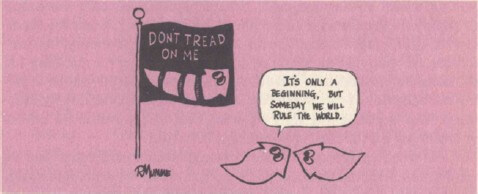
McConnell suggests these results indicate that RNA acts not only as part of the biochemical storage mechanism in most organisms, but as the transfer agent as well. In one experiment, classically conditioned animals were severed, allowed to regenerate in pond water, while others regenerated in a weak solution of ribonuclease, an enzyme that hydrolyzes RNA.
