
by Leslie Wayne
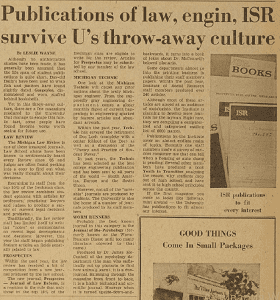
Although no authoritative studies have been made, it has generally been assumed that the life span of student publications is quite short. Day-old Daily’s have been used to wrap fish and janitors have found slightly dated Gargoyles,

In architecture, and specifically Gothic architecture, a gargoyle is a carved or formed grotesque: 6–8 with a spout designed to convey water from a roof and away from the side of a building, thereby preventing it from running down masonry walls and eroding the mortar between.
dismembered and worn, stuffed behind bookshelfs.
Yet in this throw-away culture, there are a few magazines produced by the University that manage to escape this fate. in fact, some people have found favorite works worth saving for future use.
Worm Runners
Probably the best known journal in this category is the Journal of Bio-Psychology (formerly known as the Worm Runner’s Digest until too many librarians objected to that name.)
Produced by Dr. James McConnell of the psychology department (the man who sadistically cut up planaria
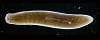
Planaria is a genus of planarians in the family Planariidae.
to find how animals learn), it is a duo-journal. Skimming through the magazine from front to back, it is a highly technical and scientific journal. However when it is turned upside-down-and-backwards, it turns into a book of jokes about Dr. McConnell’s beloved planaria.
Some departments almost co into the printing business in publishing their staff member’s papers. Within the past year, Institute of Social Research staff members produced over 240 articles.
Although most of these articles are aimed at an audience of sociologists, the Institute is planning to develop more journals for the layman. Right now, they are compiling a computerized and categorized mailing list of 6000 names.
Publications by the Institute cover an almost endless realm of topics. Recently one staff members made a survey of random consumer use that can tell when a housing or auto slump is pending. Several other members have produced a book Youth in Transition analyzing the reason why students drop out of high school, and have sent it to high school principles across the country.
It the first magazine you come to looks like fishwrap, hunt around — the University has publications to fit almost any interest.

Mark Dominus. Serendipitous Web Searches

I think it’s time to revive the planaria-themed humor magazine. Planaria are funny even when they aren’t doing anything in particular. Look at those googly eyes!
For some reason I’ve always found planaria fascinating, and I’ve known about them from an early age. We would occasionally visit my cousin in Oradell, who had a stuffed toy which was probably intended to be a snake, but which I invariably identified as a flatworm. We’re going to visit your Uncle Ronnie, my parents would say, and I would reply. Can I play with Susan’s flatworm?
The mazes were extremely simple T shapes. The planarian goes in the bottom foot of the T. Food goes in one of the top arms, always the same one. Untrained planaria swim up the T and then turn one way or the other at random; trained planaria know to head toward the arm where the food always is. Pretty impressive, for a worm.
You can still see echoes of this in the science fiction of the era. For example, a recurring theme in Larry Niven’s early work is memory RNA, people getting learning injections, and pills that impart knowledge when you swallow them. See World Out of Time and The Fourth Profession, for example. And I once had a dream that I taught a giant planarian to speak Chinese, then fried it in cornmeal and ate it, after which I was able to speak Chinese. So when I say it’s a wonderful dream, I’m speaking both figuratively and literally.
Kathleen Stein. King of Worm Runners

James V. McConnell was an American biologist and animal psychologist. He is most known for his research on learning and memory transfer in planarians conducted in the 1950’s and 1960’s. He was an unconventional scientist, setting up his own refereed journal, the Journal of Biological Psychology, which was published in tandem with the Worm Runner’s Digest, a planarian-themed humor magazine.
His paper Memory transfer through cannibalism in planarians, published in the Journal of Neuropsychiatry, reported that when planarians conditioned to respond to a stimulus were ground up and fed to other planarians, the recipients learned to respond to the stimulus faster than a control group did. McConnell believed that this was evidence of a chemical basis for memory, which he identified as memory RNA.
