
Worm-breeding with Tongue in Cheek or the Confessions of a scientist
hoist by his own petard
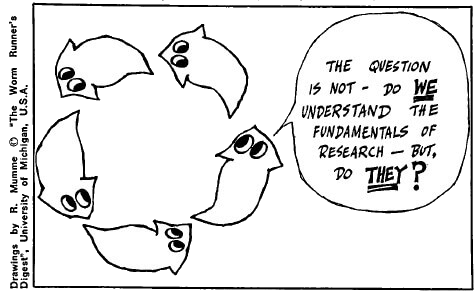
To help these poor souls out, we resorted to a propagation device much like the worm’s namely, we split in two. We gathered all of the so-called funny stuff and banished it to the back of the journal, printing it upside down to make sure that no one wouíd confuse the fact with the fancy.
The Digest inched along this way for several years, until we faced another crisis. The authors of our serious articles complained that they weren’t getting adequate coverage. When an article is published in most scientific journals, it is picked up by one of the abstracting services for dissemination in abstract form. Despite the fact that the serious side of the Digest contained some pretty meaty stuff, none of the abstracting services would touch anything that came from a journal with such an odd name as ours.
The Worm Runners Digest is interesting enough to comment on in its own right, so here are some notes from a Nov 1966 Time Magazine
 Time is an American news magazine based in New York City.
article about the official demise of the digest.

Among the fast-proliferating journals that report on assorted scientific specialties, few are even remotely comprehensible to the average layman. And many a literate scientist admits to being all but stupefied by their jargon-filled contents. One notable exception among such somber publications is the sprightly Worm Runner’s Digest, which serves up its well-edited and important scientific papers along with side dishes of humorous satires, poems and cartoons.
Now even the seven-year-old Digest has had to retreat before the tide of scientific conformity. Beginning next year, its editor announced last week, the name of the Digest will be the Journal of Biological Psychology.
Proud of It The original choice of title was not made lightly, says Psychologist-Editor James McConnell, who heads the University of Michigan planarian research group, which publishes the W.R.D. In psychological jargon,he explains, those who experiment with rats are called rat runners, and those who work with insects are called bug runners. So we are worm runners — and we’re proud of it. Not enough scientists dig McConnell’s logic — or humor. Some will not publish their work in a journal with so frivolous a name. Editors of other psychological journals refuse to allow their contributors to make any reference, however valid, to the W.R.D. We even had trouble with librarians, says McConnell.
Many of them will not order journals with odd names for their science sections. The new name, he hopes, will make the old W.R.D. more acceptable to the entire scientific community. — MathBoy’s.
Eventually, as a kind of last-ditch compromise, we petard, there was nothing we a kind of last-ditch compromise, we changed the name of the front half of the Digest, calling it The Journal of Biological Psychology.
Nothing else was changed but the name, but what a difference it made! Within two months we received letters from Psychological Abstracts,
Psychological Abstracts was an abstract and index periodical and the print counterpart of the PsycINFO database.
Biological Abstracts
Biological Abstracts is a database produced by Clarivate Analytics.
and Chemical Abstracts
 is a division of the American Chemical Society.
asking that we send them this new journal for abstracting. Naturally, we obliged.
As I look back at the past 16 years or so, it becomes apparent to me that life would have been a lot easier had the Digest suffered a stillbirth. Much of the controversy surrounding the work on memory transfer stems in no small part from the fact that it received its first publication in what some of my colleagues still refer to as the Playboy
 Playboy is an American men’s lifestyle and entertainment magazine, formerly in print and currently online.
of the scientific world.
I can recall attending a meeting at Cambridge in 1964 at which I presented what seemed to me to be rather conclusive evidence that memories could be transferred chemically from one planarian to another. Afterwards, over the inevitable soggy cookies and warm, flavoured water, I was taken to task by a noted Scientist who informed me flatly that he would refuse to consider seriously anything published in a scientific cartoonbook. When I asked him which of the British journals he had reference to, he almost dropped his cookie.
I can also remember when a good friend of mine took me aside one day to tell me how much damage I was doing to my reputation by printing the Digest. He was really quite worried about the matter.
WORM RUNNER’S DIGEST
TABLE OF CONTENT
Volume 13 Issue 1
Published Jul 1, 1971
- James V. McConnell. Worms (and Things.)
- S. J. Coward. & R. O. Calpe. Bihaviorally Significant Surface Sprcifications of the Planarian, Dugesia dorotocephala.
- Dominic J. Constanzo & Webster G. Cox. Habit Reversal Improvement in Crayfish.
- Marion Harless. Isopods as Subjects for Behavior Research.
- Sam. L. Campbell & Stanley H. Holgate. Temperature Selection in Two Subspecies of Beetle.
- Rodney C. Bryant. Transfer of Light-Avoidance Tendency in Groups of Goldfish by Intracranial Injection of Brain Extract.
- Randall Morton & Paul Kleinginna. Running Speed & Mortality Rate of Bipalium kewense as a Function of Different Levels of Illumination.
- H. P. Zippel & G. F. Domagk. Transfer of Color & Taste Preference from Double-Trained Goldfish (Carassius auratus) into Untrained Recipients.
- William E. Datel & Llewellyn J. Legters. Reinforcement Measurement in a Social System.
- W. C. Corning. Conditioning & Transfer of Training in a Colonial Ciliate: A Summary of the Work of N. N. Plavilstchikov.
- Robert Thompson & Edward L. Walker. Book Reviews.
- Various. A Semi-Annotated Bibliography of Research on Invertebrates.
- Jessy Shelby. An Annotated Bibliography of Research on Vertebrates.
Volume 13 Issue 2
Published Dec 1, 1971
- James V. McConnell. Worms (and Things.)
- Carl C. Lindegren. The Mitochondria as Vehicles of Entry & Transport.
- William G. Braud, Porter V. Laird & Steven J. Richards. Facilitation of Avoidance Behavior in Goldfish by Injection of Brain Materials from Trained Donors: Effect of Injection-Testing Interval.
- Hans Peter Zippel, Barbara Bieck & Klaus Rueckert. Studies on Extinction in Goldfish (Carassius auratus): A Comparative Account of Learned & Transfered Information.
- B. Bieck & H. P. Zippel. Spontaneous Behavior & Taste Discrimination in the Goldfish (Carassius auratus) After a Shock-Free Training Procedure.
- Marion D. Harless & Charles W. Lambiotte. Behavior of Captive Ornate Box Turtles.
- Thomas E. Hanzel & William Rucker. Escape Training in Paramecia.
- Marilyn Stewart, Doreen Strachman & William Rucker. Interanimal Transfer of Training: A Pilot Study of Direction of Effect.
- R. Bisping, O. H. Zahl-Begnum, N. Longo, U. Niemoeller & H. Reinauer. The Effects of Nucleic Acid Concentration on Biochemical Memory Transfer.
- Robert C. Taylor. Instrumental Conditioning & Avoidance Behavior in thevCrayfish.
- Charles C. Cleland & Jon D.Swartz. Comparative Psychology of Folklore.
- Jon D.Swartz. Book Reviews: Human Populations, Genetic Variation and Evolution, Laura Newell Morris (Ed.)
- Edward J. Callahan. Contingencies of Reinforcement: A Theoretical Analysis, B. F. Skinner.
- Rodney C. Bryant & Fredrrick Petty. Chemical Transfer of Learned Information, Ejnar J. Fjerdingstad (Ed.)
Volume 14 Issue 1
Published Jul 1, 1972
- James V. McConnell. Worms (and Things.)
- S. J. Coward & J. W. Piedilato. The Behaviors Significance of the Rhabdite Cells in Planarians,
- Porter V. Laird, William G. Braud & Ronald B. Hoffman. Brain Extracts from Donors Exposed to Inescapable Stressors Modify Shock-Avoidance Learning Rate in Recepient Goldfish.
- Marione Hariess. A Primer of Zoological Taxonomy for Psychologists.
- Carl D. Cheney & Val Tam. Interocular Transfer of a Line Till Discrimination Without Mirror Image Reversal Using Fading in Pigeonc.
- Robert J. Kirkby & Alan C. Preston. The Behavior of Marsupials. II. Reactivity & Habituation to Novelty in Sminthopsis crassicaudata.
- L. K. Losina-Losinskij. Phenomena of Chemotaxis in Connection with the Selection of Food by Infusoria.
- D. J. Costanzo, O. R. Rudolf & W. Cox. Social Status & Habit Reversal Learning in Crayfish.
- Charles C. Cleland, Robert C. Reinehr, Keith F. Bell, Luis M. Laosa, Jon D. Swartz. Book Reviews (Edited by Jon D. Swartz.) The Pre-Columbian Mind, Francisco Guerra, Symbiosis, Thomas C. Cheng, Methods in Psychobiology, Vol. 1. Laboratory Techniques in Neuropsychology & Neurobiology, R. D. Myers (Ed.,) Curable & Incurable Neurotics, Edmund Bergier, Behavior Modification: An Overview, William L. Mikulas, Handbook of Reason, Dagobert D. Runes, Statement on Race, Ashley Montagu, Habits:Their Making & Unmaking, Knight Dunlap
Re Reviewers & Reviewed, Forthcoming Reviews, Books Received. - Joseph C. Huber, William B. Rucker. An Addendum to Corning & von Burg’s Protozoan Learning — A Bibliography.

