
by Jill Oserowsky
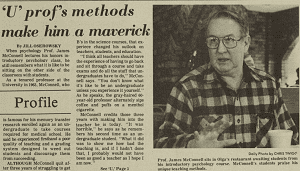
When psychology Prof. James McConnell lectures his honors introductory psychology class, he still remembers what it is like to be sitting on the other side of the classroom with students.
As a tenured professor at the University in 1963, McConnell, who is famous for his memory transfer research enrolled again as an undergraduaye to take couesws required for medical school. He said he experiences firsthand a poor quality of teaching and grading system designed to weed out students and discouragw them fron succeeding.
Although McConnell quit after three years struggling to get B’s in the science courses, that experiece changed his outlook on teachers, students, and education.

I think all teachers should have the experience of having to go back and through a course and take exams and do all the staff that undergraduated have to do,, McConnell says. You don’t know what it’s like to be an undergraduate unless you experience it yourself.
As he speaks, the gray-haired 60-year-old professor alternately sips coffee and puffs on a menthol cigarette.
McConnell credits those three years with making him into the teacher he is today.
It was horrible he says as he remembershis second time as an undergraduate student. What it did was to show me how bad the teaching is, and if hadn’t done that, I probably would not have been as good a teacher as I hope I am now.
U teaching methods need to change, Prof. Says
As his students in honors introductory psychology course finish taking an examination in the Modern Languages Building, McConnell talks slowly and deliberately while he awaits their arrival nearby Olga’s restaurant.
During the next hour, the students will join him one at a time, with their completed tests in hand. After the students hand in their tests he will offer them a few dollars to buy a coke or something to eat, drink, or be merry with.
McConnell is well-known at the University for his controversial grading system. If student does all the required work and performs to the levelexpected by McConnell, he or she receives an A in the course. McConnell doesn’t believe in surprising students — before a test, he gives them a group of sample questions from which he chooses the test questions.
Students and colleagues agree the McConnell’s teaching meyhods are unorthodox, but effective.
LSA senior Gary Sugarman heard about McConnell’s class three years ago ago in the Honors Program
Honors Program are special accommodation constituent programs at public and private universities – and also public two-year institutions of higher learning – that include, among other things, supplemental or alternative curricular and non-curricular programs, privileges, special access, scholarships, and distinguished recognition for exceptional undergraduate scholars.
office. People warned him not to take the course, saying that he would learn nothing and earn an easy A. Sugarman took the course despite that advice and is glad he did.
McConnell doesn’t trach an easy class, said LSA sophomore Brenda Montgomery,
It’s not a blow-off class by any means, Montgomery said. He’s really concerned with us learning, whereas other people are concerned with their teaching methods.
McConnell criticizes the quality of classroom insruction at the University.
At Michigan we believe the only way to maintain quality is to throw people out, to make the teaching so bad that the students can’t learn ,,, so you flunk a given percentage of people, he said. To me that as utter balderdash, he adds emphatically
McConnell received criticisnm for his research in the 1960s when discovered that memory is transmitted chemically. In the study, he fed brains of trained worms to untrained worms. The untrained worms then demonstrated the skills of the trained worms.
McConnell’s slow, almost lazy voice becomes more animated as he describes the experiment. His left hand holds a coffee stirrer representing the worn while his right hand points at the head and tail for emphasis.
The cannibalism study was controversial and ahead of its time, according to McConnell. Most recently he was worked on studies involving autistic children’s learning behavior.
McConnell sees himself as a maverick in the psychology department.
I amn’t universally loved in in the department to say the least, he laughs.
But psychology Prof. Wilbert McKeachie
Wilbert J. McKeachie was an American psychologist.
has only for the professor.
He’s excellent teacher, a very good lecturer, and very good writer McKeachie said. His system does facilitate learning, but it’s different than most.

H. Brown, B. Corbett. On the Solution of All Philosophical Problems Through the Consistent Application of the Peter Principle
I
A) Why is there anything rather than nothing? Originally there was nothing. Since this was working out quite well, nothing was promoted to something which it has been doing incompetently ever since.
B) What is the nature of the relation between mind and body? Previously there was no relation between mind and body. They were not on speaking terms and had absolutely nothing to do with each other. Since this was thoroughly efficient arrangement, mind was promoted to the job of controlling the body, which it has been doing incompetently ever since.
II
Let us attempt to apply our method to the problem of freedom and determinism. We could argue that man was originally free and that since this worked well, freedom was promoted to determinism at which it is incompetent. But it is equally plausible to argue that man began in a state of competent determinism which was then promoted to incompetent freedom. Clearly, we have no way of choosing between these arguments. Thus the Peter Principle cannot solve this problem; in attempting to use the Peter Principle to solve all philosophical problems we have promoted it to its level of incompetence from which we infer that the method of complete. This inference is surely incompetent, which we take to be a further proof of our thesis.
Текст публикуется по The Worm Runner’s Digest том 17, 1975 стр. 105
Hank Davis and Susan Simmons. An Analysis of Facial Expressions in the Rat
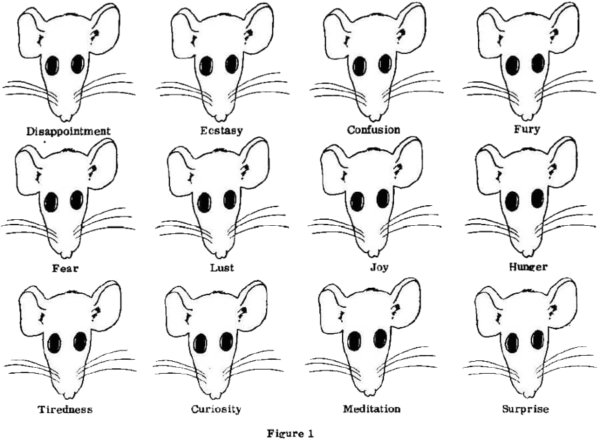
It has long been that facial expressions may be a sensitive indicator of an organism’s emotional state. Who can forget Darwin’s classic work, The Expression of the Emotions in Man and the Animals, in which he painstakingly catalogued the faces of primates to illustrate his point. This area of investigation has found favor with modern researchers as well. Mariott and Salzen have analyzed the facial expressions in a colony of captive squirrel monkeys and they, like Darwin, have concluded that a smile is worth a thousand words. All things considered, it is really surprising that no one has gone to the trouble to record and analyze the facial expressions of the ubiquitous rat. This surely must be an oversight and we intend to put things right. There has, of course, been related work with mice (Disney), thus indicating that the problem is not in soluable. A little effort is all that’s needed. If we’ve learned anything from the past decade of animal psychology, it’s that we must really know our subjects before we can work with them. And what better way to know anyone than to study his or her face?
Method
Subjects. Our subjects came from a colony of laboratory rats. We could only get used ones, so they came to us in a variety of moods; some happy, some sad, some scared to hell, depending upon the studies in which they’d participated.
Procedure. We watched our subjects for three months. Really watched them. Then we drew them.
B) What is the nature of the relation between mind and body? Previously there was no relation between mind and body. They were not on speaking terms and had absolutely nothing to do with each other. Since this was thoroughly efficient arrangement, mind was promoted to the job of controlling the body, which it has been doing incompetently ever since.
Procedure. We watched our subjects for three months. Really watched them. Then we drew them.
