
J.D. Anonymous
Дж. Д. Аноним. Семь правил написания малопонятной научной статьи
Представлены семь часто иллюстрируемых правил. Их соблюдение гарантирует едва внятную писанину в научных статьях.
Cnfnmz опубликована в VI томе (вып. 2) Журнала Дрессировщика Червей.
Представлены семь часто иллюстрируемых правил. Их соблюдение гарантирует едва внятную писанину в научных статьях.
Cnfnmz опубликована в VI томе (вып. 2) Журнала Дрессировщика Червей.
Rule 1. The first principle is supremely important, but difficult to define. Despite this handicap, many people seern to be able to master the basic technique. In order to apply this principle, the author must live with his experiment and its specialized literature for an extended period of time. During this time he will be able to develop a series of mental short-cuts in his thinking about the project and an esoteric jargon for describing it. The trick lies in then writing the paper immediately and without coming out into real world. Doing this will ensure that most of the short-cuts and a large part of the peculiar vocabulary will be incorporated into the paper.
Rule 2. Never use a short word if a longer synonym for it can be found and if this can be accomplished without doing absolute violence to the meaning, never use a simple word if an exotic one can be substituted for it. For example, use explicate for explain, replicate for repeat, and asymmetric for unequal or uneven. (I do not mean to imply that explicabe and replicate and asymmetric are words co be avoided when they are used in a technical setting. I am referring co such sentences as Explicate that or He made replicated trips co the bathroom or Good King Wenceslas looked out on his feets asymmetric.)
Rale 3. Go through the manuscript grouping short sentences together into longer ones by substituting commas for periods.
Rule 4. Lapse into abbreviations at every opportunity. A sentence that begins The DRT group, in contrast to the GTR-2 group, showed no trend with respect to the RQ-Z scores, … is almost sure to lose the reader. The author can enhance the effectiveness of this technique by making sure that each abbreviacion is defined ambiguously or incompletely and by scattering the definitions through the body of the paper so chat they are difficult to find.
Rule 5. Make different clauses in the same sentence non-sequitur. For example,

In attempting to explicate memory processes, usual methods of measuring memory for order are markedly artificial in that this sentence means chat markedly artificial methods of measuring memory for order are attempting to explicate memory processes.
Repeatedly use this technique throughout the length of the paper.
Rule 6. Start a running theoretical argument, and then leave it flat and unfinished by the device of (Ziblich, 1958). This method gains effectiveness if several trains of thought are introduced one after another (Smith & Dee, 1921), to say nothing of a third viewpoint (Jackson & Simpson, 1963, private communication). Note that, in order to follow the argument, the reader will have to consult a number of references. In using this device, it is always wise to make the decisive point by referring to a source that the reader cannot possibly have at his disposal.
Rule 7. Be sure that the figures, tables, and charts are confusing. In particular, try to cram as much detailed information into each of them as possible. (I have a separate sec of rules for generating such figures, but space is limited and I shall not append it here.)
1 The rules were originally contained in a letter reviewing a manuscript for this Journal. The author(s) of the reviewed paper suggested that the material deserved to be printed as a note, and the rules are reproduced hete with slight editorial modification. Reprints may be obtained upon request from Psychological Reports, Box 1441, Missoula, Montana. — Requested by the Editors.
Have You Lost Your Mind?

Scientists have famously described the planarian flatworm as being
immortal under the edge of a knife.
Because these half-inch long, seemingly unremarkable invertebrates possess the extraordinary ability to regenerate lost body parts.
Like a lizard growing back its tail? you might ask.
Not exactly.
Consider this:
If you cut off a planarian’s head, it will grow back, brain and all.
If you slice a planarian lengthwise or crosswise, its divided body will regenerate into two separate, whole individuals.
If you snip off a bit of a planarian as small as 1/279th its total size, that tiny morsel can regenerate into a complete organism in a few weeks.
If you think that’s amazing, listen to this:
If you cut the head of a planarian in half and leave the halves dangling on the organism’s body, the planarian can regenerate two whole heads on its single body and continue to live.
And while this little creature’s regenerative ability is worthy of awe and wonder, there’s much more to the story.
Back in the 1950-60s a very unconventional psychologist and researcher, James V. McConnell conducted some provocative experiments with planaria. The experiments involved instilling the worms with memories through training, then cutting off their heads (brains and all) and allowing them to regrow. After the animals had fully regenerated themselves, McConnell tested to see if the animals might have retained the memories he’d instilled before decapitating them.
Remarkably, his results suggested they had.
But how could that be??
Everyone knows memories are stored in the brain — a specific brain — so how could the new brain possess the memories discarded with the lopped off old brain??
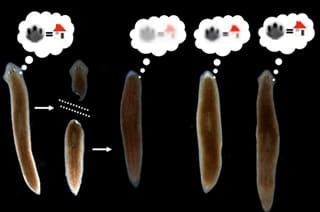
Despite prevailing opinion, the results led McConnell to suggest that memories were not stored in the planarian’s brain at all, but elsewhere in its body and possibly within a component similar to RNA.
His disturbing theory was promptly ridiculed and set aside. (Not the first scientist to endure a harsh reception to unconventional results.)
Flash forward several decades to 2013 when two developmental biologists at Tufts University decided to reproduce McConnell’s experiments — making significant improvements in method, objectivity and evaluation.
You can read all the details about how they conducted the training and experiments on their planaria here.
Suffice it to say, their results supported McConnell’s observation that planaria can lose and regrow their entire head and brain and still retain memories that were instilled prior to decapitation.
In short, these scientists now support McConnell’s highly-criticized hypothesis that a planarian’s memories are not stored within the creature’s brain, but elsewhere.
So what does all this mean?
I think it means the conventional thinking on memory formation and storage needs to be re-imagined.
Up until now it’s been assumed that memories are stored in the organic matter of the brain. This belief is supported by the overwhelming evidence that creatures with damaged brains either lose memories entirely or have difficulty accessing them.
But is this the only conclusion that can be drawn from such evidence?
What if the brain is not the site of memory storage but rather the tool for retrieving memories from elsewhere? So that damage to the brain does not damage the memory itself but the tool necessary for accessing it?
In this case the clinical results would be the same (a victim of brain damage would struggle with memory recall or fail at it entirely) — but for an entirely different reason.
It is certainly provocative to contemplate the idea of memories being stored and retrieved from throughout the body, rather than solely within the brain.
As speculated in an earlier Wonderchew, isn’t the realm of memory far too complex and multifaceted to be overseen by a single organ? And shouldn’t we broaden our thinking to include the possibility that it isn’t?
The planarians and their lost minds seem to suggest we should.
