
Worm-breeding with Tongue in Cheek or the Confessions of a scientist
hoist by his own petard
by James V. McConnell
Many of the brighter students in the biological sciences saw immediately that the worm could make an intriguing and most inexpensive substitute for the rat. So in 1959 we were inundated with letters from these bright youngsters asking us to tell them all about the care and training of worms (a few more aggressive souls wrote us demanding that we send them a few hundred trained animals.)
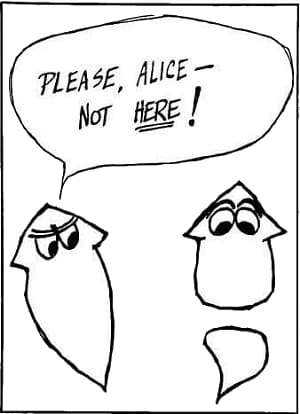
I answered the first few letters personally at great length, but when several hundred arrived, it became clear that some more efficient means of communication would have to be arrived at. So my students and I sat down and wrote what was really a manual describing how to repeat the sorts of experiments we had been working on.
It took us all of fourteen pages to pour out our complete knowledge of planarianology. We typed the material up and reproduced it on ditto paper (using purple ink garanteed to fade rapidly so that years later we wouldn’t be embarrassed by residual displays of our yourthful ignorance.)
Now, I had always been noted for the oddness of my sense of humour, and the planarian research greatly enhanced this reputation. Thus none of my students considered it strange that we should try to make a joke out of this little manual, so joke it became.
First of all, it had to have a name. In psychological jargon, a person who trains rats is called a rat runner, because, presumably, his task is to get the rats to run through a maze or some other piece of apparatus. A man who trains insects is a bug runner, and someone who works with humans is, quite seriously, called a people runner. Obviously we were worm runners, and so the title of our manual simply had to be Worm Runner’s Digest.
One of the girls designed a crest that appeared on the cover, with a rampant two-headed worm, a coronet of connected nerve cells at the top, a Latin
 Latin is a classical language belonging to the Italic branch of the Indo-European languages.
motto (which Arthur Koestler translate as when I get through explaining this to you, you will know even less than before I started,) an S and R for stimulus-response, a ψ for psychology, and a pair of diagonal stripes painted the maize-and-blue colours of the University of Michigan (it wasn’t until years later that we learned that in the language of heraldry,
 Heraldry is a discipline relating to the design, display and study of armorial bearings, as well as related disciplines, such as vexillology, together with the study of ceremony, rank and pedigree.
diagonal stripes across your escutcheon mean that you’re descended from a bastard; as I like to say, there’s been a good deal of serendipity in our research.) To top the manual off, we called it Volume I, No. 1, the joke being that we had no intention of continuing its publication. Little did we appreciate the strength of the publish-or-perish syndrome. Academic scientists are so desperate that they will publish anywhere (for the Dean really doesn’t know the difference,) so to our utter amazement, we began getting contributions for the next issue. Hoist with our own could do but put out a next issue, and a next, and a next…
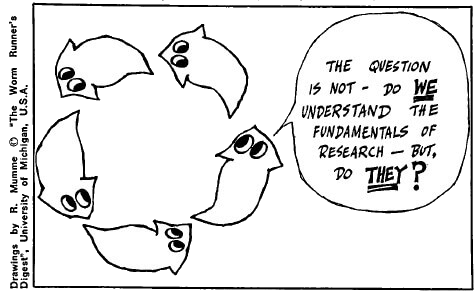
And now, here we are, a journal with 16 years behind us, an international circulation that today is numbered in the thousands. One of our crowning achievements, incidentally, was the receipt of a letter from the Library of the Academy of Sciences of the U.S.S.R. offering an official exchange of journals. We wonder still if they quite knew what they were getting.
Of course, even as our circulation increased, we remained unique. We decided that most scientific journals are deadly dull, and ours would be different. To pep things up a bit, we included poems, joke’s, satires, cartoons, spoofs and short stories scattered more or less randomly among the more serious articles. People seemed to like this melange; or at least, some of them did. A few people complained that they didn’t have time to waste on the sophomoric humour they wanted the truth and nothing else.
Their trouble was that they often found themselves getting halfway through a satire before they realized that their leg was being pulled.
We would have ignored such complaints had they not come from some of the most famous and influential members of the scientific community.
WORM RUNNER’S DIGEST
TABLE OF CONTENT
Volume 12 Issue 1
Published Oct 1, 1970
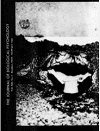
- James V. McConnell. Worms (and Things.)
- Richard E. Blackwelder, Taku Komal, Masaharu Kawakatsu, William K. Emerson. Libbie Henrietta Hyman Memorial: Her Life, Her Colleagues, Her Work.
- S. J. Coward, H. C. Gerhardt & D. T. Crockett. Behavioral Variation in Natural Populations of Two Species of Fiddler Crabs (Uca) & Some Preliminary Observations on Directed Modifications
- Robert Boice & Carol Boice. Interspecific Competition in Captive Bufo marinus & Bufo americanus Toads.
- Richard L. Greene & Joseph W. Jennings. Apparatuses for Assessing Maze Learning in the Isopod (Porchellio scaber.)
- H. LeVan, W. S. Moos & H. C. Mason. Alteration of Transferability of Radiation-Induced Behavior by Dimethyl Sulfoxide in Mice.
- Stanislav Reinis. Effect of 2,6-Diaminopurine & 6-Mercaptopurine on Learning in Mice.
- Georges Chapouthier, Sylvie Spitz, Daniele Legrain & Ariele Ungerer. Effect of Brain Extracts from Mice Injected into the Mother on Learning Ability in the Offspring.
- G. M. Cartwright. Use of the Maze Habit as a Test of the Specifity of Memory Transfer in Mice.
- William G. Braud. The Goldfish as a Subject for Psychological & Physiological Research.
- Ottys Sanders & Ruth M. Sanders. Webs Secreted by Planarians.
- Marie M. Jenkins. Sexuality in Dugesia dorotocephala.
- M. Benazzi, E. Gianini & I. Puccinelli. Kariological Research in the American Planarians Dugesia dorotocephala & Dugesia tigrina.
- Arthur Cherkin. Failure to Transfer Memory by Feeding Trained Brains to Naive Chicks.
- Elaine Levy, Arron Allen, William Caton & Eric Holmes. An Attempt to Condition the Sensitive Plant: Mimosa pudica.
- J. S. & L. Tomlinson. Bihavioral Taxes as Segment of an Acuity Continuum.
- W. C. Corning & R. von Burg. Protozoan Learning — A Bibliography.
- Margaret L. Clay. Book Review.
- Letters in the Editor.
Volume 12 Issue 2
Published Dec 1, 1970
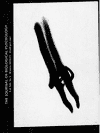
- James V. McConnell. Worms (and Things.)
- H. P. Zippel & G. F. Domagk. Spontaneous Behavior & Color Differentiation in the Goldfish (Carassius auratus) after a Shockfree training procedure.
- H. P. Zippel & B. Bieck. Interaction of Color & Taste Stimuli During a Stimulaneous Double-Training of the Goldfish (Carassius auratus.)
- C. D. Cheney. Transfer of Response Rate Bias in Rats by Injection of Brain Homogenate.
- B. G. Benner & G. Radcliffe. Induction of Conditioned Avoidance in Unreinforced Recipient Rats Treated with Brain Extracts from Conditioned Donors.
- M. L. Cheal. Effects of Whole Brain Homogenate on Multiple Schedule in Rats.
- L. K. Oliver. The Effects of Single Versus Pooled Rat Brain Extracts on Recipient Behavior.
- C. I. Cuilliams & Craig Harris. Accelerated Conditioning of Contracted immobilized Planarians.
- W. E. Datel & L. J. Letgers. The Psychology of the Army Recruit.
- R. G. Holroyd. On Sex Distribution of Children Within Families.
- S. J. Coward. Academic Gamesmanship, How to Make a Ph. D. Pay, Pierre van den Berghe.
- R. Thompson. A Stereotaxic Atlas of the Developing Rat Brain. N. M. Sherwood & P. S. Timiras.
- L. K. Oliver. Molecular Approaches to Learning & Memory. W. L. Byrne (Ed.)
- R. E. Ward, A. E. Adelson. The Law Unto Themselves. P. R. Runkel.

