
Worm-breeding with Tongue in Cheek or the Confessions of a scientist
hoist by his own petard
by James V. McConnell
Not able to convince the tail to get on with it, the head does the next best thing: it pulls so hard that the whole animal comes apart at the middle. The head then wanders off, leaving the tail to manage as best it can.
Now, if you cut a human being in half across the waist, he has a tendency not to survive the operation. But if you do this to a flatworm, you merely trigger off asexual reproduction in the same way that the animal occasionally does itself. For the head will grow a new tail in a matter of five or six days, and the tail, clinging gallantly to its rock, will regenerate an entire new head in a matter of a week or two.
Furthermore, each of the regenerated portions of the beast will soon grow up to the same size as the original animal and, being rejuvenated as well as regenerated, will begin sexual mating again. Thompson and I, knowing this odd habit of the flatworm, thought it might be clever if we trained a worm, then cut it in half, let the head grow a new tail and the tail grow a new head, and then tested both halves to see which half remembered the original training.
Thompson and I never had the time to do that experiment at the University of Texas, but at Michigan I had students, worms and apparatus, so we set out to see what would happen.
To our great surprise, we found that the heads remembered just as much as did worms that had been trained but not cut in half at all. Apparently, if you are a worm, losing your tail does not affect your memory. To our greater surprise, we found that the tails remembered even better than did the heads. Obviously, for worms, losing your head actually improves your memory!
These odd results suggested to us that, in the planarian at least, memories might not be stored just in the head section. Our next experiment consisted of chopping a trained animal in several pieces and letting all of them regenerate. As we half expected, each regenerate showed memory of what the original animal had been taught.
Slowly it began to dawn on us that the usual theories of memory storage just didn’t hold, for these all insisted that memories were stored neurophysiologically in the brain. Since our regenerated worms had to re-grow an entire new brain, it seemed to us that they must be storing their lessons chemically.
In other words, whenever the worm learned something, there had to be some corresponding change in the molecules in their bodies. Our chemical theory of memory was interesting, but how to go about proving it?
People have personalities and, after you’ve studied them a while, it becomes apparent that planarians do, too. That is, each organism reacts slightly differently from its cousins and brothers.
But chemical molecules are all supposed to be the same. So, when one worm learned his lesson in our training apparatus, we assumed that the chemical changes inside his body were more or less the same as those that would take place in any other worm’s body when it learned the same lesson. Now, that’s a perfectly tenable hypothesis if you don’t happen to know much about zoology or biochemistry so, blessed with a most enthusiastic ignorance of such arcane topics, we ploughed ahead. Here was our reasoning. Worms are rather special. Not only can you cut them in half, and each piece will regenerate into an intact organism, but you can also play all sorts of sadistic games with them.
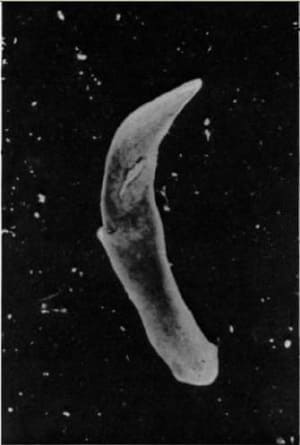 If you slice the head in half, from the tip of the snout down to where the worm’s Adam’s apple would be (if it had one, which it doesn’t), and then you keep the two sections of the head separated for 24 hours, each section will regenerate separately. You’ll end up with a two-headed worm. Interestingly enough, a chap at Washington University in St. Louis worked with two-headed planarians later on and found, to our delight, that these animals learn significantly faster than do normal beasts. So, as far as the worm is concerned, two heads are indeed better than one!
And if two heads aren’t enough for you, split each of them again, and you’ll have four heads on the same body. You can get up to twelve heads at once, if you and the worm are interested in such things. More than that, you can take the head from one animal and graft it on to another planarians don’t reject tissue grafts the way that most higher organisms do.
WORM RUNNER’S DIGEST
TABLE OF CONTENT
Volume 10 Issue 1
Published Jul 1, 1968
- James V. McConnell. Worms and Things.
- Henry Altschuler, M. H. Kleban, M. Gold, M. Lawton & M. Powell. Chemical Changes in the Brain & Their Relationship to Donor-Recipient Transferred Avoidance Behavior in Rats.
- Selby H. Evans. Chemical Programming in the Brain: Speculations.
- G. A. Browne, J. S. Pollard & A. M. Lysons. Learning in Sea Anemones?
- B. B. Togrol. The Effect of Drugs on the General Behaviour, Regeneration & Learning Capacity of Planarians.
- James Welsh. U. S. Office of Education’s New Basic Research Thrust.
- Stanford L. Engel & David Frost. Work in Progress in the Biological Sciences.
- Arnold M. Golub. Book Reviews.
- Judy Tunkl. An Annotated Bibliography of Research on Planarians: Part XII.
- Judy Tunkl. A Bibliography on Chemical Transfer of Training in Vertebrates.
- John C. McClellan. The Bar Sinister.
- Ian Rose. Robert’s Rules of Unparliamentary Procedure.
- Theodore D. Wachs. Three Folk Songs for Psychologists.
- L. F. Quattlebaum. A Case History of Extinction of Deviant Verbal Behaviour Without Awareness.
- J. A. Lindon. On First Looking into McConnell’s Manual (Part I.)
- F. Barry Milligan. Life Returns at the University.
- Various. Letters to Editor.
Volume 10 Issue 2
Published Dec 1, 1968
- James V. McConnell. Worms (and Things.)
- Blanche E. Julian & Ann M. Richardson. Maze Learning vin the Lizard Dipsosaurus dorsalis.
- John A. Corson & Hildegard E. Enesco. Attempts of Obtain Information Transfer in Rate With Brain Extracts.
- Arnold M. Golub. Negative Results in Memory Transfer Studies: A Response to Drs. Corson & Enesco.
- Frederic Walker. The Iconoplast.
- James V. McConnell, Tsuyoshi Shigehisa & Harold T. Salive. Attempts to Transfer Approach & Avoidance Responses by RNA Injections in Rat.
- Marlys Scutjer. The Annotated Bibliography of Research on Planarians, Part XIII.
- Marlys Scutjer. A Bibliography of Chemical Transfer of Training in Vertebrates.
Volume 11 Issue 1
Published Sep 1, 1969
- Arnold M. Golub, Leon Epstein & James V. McConnell. The Effect of Peptides, RNA Extracts, and Whole Brain Homogenates on Avoidance Behavior in Rats
- Robert E. Hancy. Classical Conditioning of a Plant: Mimosa pudica.
- Marie M. Jenkins. Effect of Light on Feeding in Planarians.
- Frederic D. Kemp. Thermoregulatory Operant Behavior in the Lizard Dipsosaurus dorsalis as a Function of Body Temperature, Substrate Temperature, and Heating Rate.
- James V. McConnell. Worms (and Things.)
- Office of Education, H. E. W. Announcement.
- J. F. Patin. The Effect of Light Intensity & Temperature on the Rate of Locomotion of the Planarian Polycelis nigra.
- J. S. Pollard & R. F. V. Lewis. Ferrets Do Learn Mazes.
- Robert Saum, David L. Andes, Alexander J. E. Park and Marie M. Jenkins. Ability of Dugesia dorotocephala to Adjust the pH of the Environment.
- Marlys Schutjer. A Bibliography of Research on the Biochemistry of Memory in Vertebrates.
- Marlys Schutjer. The Annotated Bibliography of Research on Invertebrates, Part XIV.
- Peter H. Wagschal. Psychology & Model-Building: The Orienting Response.
- Raymond J. Corsini. Dhe Blind Men and the Elephant: Three Ends to One Tale.
- Tollan Dymas. Under Worm Wood.
- Roger Hayward. The Jigsaw Puzzle & the Inventive Mind.
- Joanna Kuszajewski. Regeneration Experiments on Planarians.
- Letters to Editor.
- John McClellan. Kennelworth.
- John J. Miller & Richard T. Walls. Puck’s Primer of Primigenial Psychological Phrases.
- M. Ian Phillips. Is Memory a Disease?
- Peter Runkel. Some Funny Things Happened to Me on My Way to the Asylum.

