
by John V. Hagopian
Джон В. Хагопиан. Профиль факультета
Коллега Джеймса Макконнелла описывает его работу в колледже литературы, науки и искусства.
Коллега Джеймса Макконнелла описывает его работу в колледже литературы, науки и искусства.
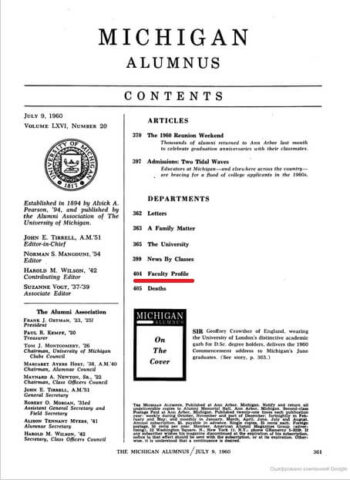
The Michigan Alumnus 404
It is not any longer a safe assumption that a psychologist is a scientist who studies the human mind. Some do, but many — the hard psychologists — believe that the human organism is much too complex and that research on humans is much too restricted by social and moral taboos for there to be much hope of reliable hypotheses and theories.
To be sure, clinical and social psychologists still constitute the majority of members of the American Psychological Association,
 The American Psychological Association is the largest scientific and professional organization of psychologists in the United States, with over 146,000 members, including scientists, educators, clinicians, consultants, and students.
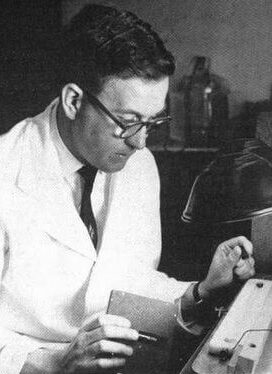
but their experimental colleagues often consider them soft in the hard-fact foundations of their work. The simpler the organism, the more possible is rigorous laboratory control and study of its behavior. Therefore, experimental psychologists are generally rat men. James Vernon McConnell, assistant professor of psychology at Michigan, is even harder than that — he is a worm man.
How he got that way is a complex story. In high school, Jim McConnell was a biology major and won second prize for an exhibit at the Louisiana State Fair. On the side he held down a 40-hour-a-week job as cub reporter with the Shreveport Times.
 The Times is a Gannett daily newspaper based in Shreveport, Louisiana.
After getting his A.B. at LSU in 1946, he planned to attend Columbia University
 Columbia University, officially titled as Columbia University in the City of New York, is a private Ivy League research university in New York City.
for an M.A.
 A Master of Arts is the holder of a master’s degree awarded by universities in many countries.
in English, but was detoured by a series of attractive radio and television jobs. Many of his shows were aired nationally over NBC
 The National Broadcasting Company is an American English-language commercial broadcast television and radio network.
and several won prizes. In 1951 McConnell returned home to take over the family business and discovered that not being in television was equal to not getting an ulcer. He later enrolled in clinical psychology at the University of Texas
 The University of Texas at Austin is a public research university in Austin, Texas.
and spent the summer of 1952 as a psychologist with an archeological expedition in Mexico.
 Mexico, officially the United Mexican States, is a country in the southern portion of North America.
His observations of the primitive Tehepuan Indians
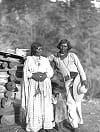 The Tepehuán are an indigenous people of Mexico.
were embodied in his first professional publication. Eventually McConnell shifted from clinical psychology to social and finally to experimental psychology.
 Experimental psychology refers to work done by those who apply experimental methods to psychological study and the underlying processes.
Together with another Texas graduate student he set up a simple apparatus in the kitchen of his apartment and performed the first experiments proving that flatworms could be conditioned. The results were published in the Journal of Comparative
Comparative psychology refers to the scientific study of the behavior and mental processes of non-human animals, especially as these relate to the phylogenetic history, adaptive significance, and development of behavior.
and Physiological Psychology.
Physiological psychology is a subdivision of behavioral neuroscience that studies the neural mechanisms of perception and behavior through direct manipulation of the brains of nonhuman animal subjects in controlled experiments.
Joining the Michigan faculty in 1956, McConnell continued his research on flatworms with the help of some graduate students. After conditioning worms to respond to flashes of light, he cut them in half and allowed them to regenerate. Then he tested them to see if they would retain traces of their original learning. To his joy, the tails, which contained little of the original nervous tissue, remembered as much as did the heads. This strange phenomenon persisted through several generations. The implications for the hereditary transmission of learned characteristics are obvious and astounding.
It would be misleading to suggest that McConnell has exclusively narrowed the focus of his attention to worms. He continues to work at all levels of psychology, soft and hard. Not only is he
directing experiments on a higher level than worms, but on an even lower level — plants. Experiments justify a tentative hypothesis that learning or conditioning occurs in the Venus flytrap.
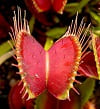 The Venus flytrap (Dionaea muscipula) is a carnivorous plant native to subtropical wetlands on the East Coast of the United States in North Carolina and South Carolina.
In the area of human engineering, behavioral influence, persuasion techniques, and motivation, he has served as a consultant for the Department of Defense. He has planned two new books: An Introduction to Psychology and Influence. In addition to teaching, writing, and research, he has been academic counselor for juniors and seniors in psychology and is presently chairman of the psychology department’s Committee on Undergraduate Studies.
WORM RUNNER’S DIGEST
TABLE OF CONTENT
Volume 6 Issue 2
Published Oct 1, 1964
- James V. McConnell. Worms …
- Clifford Fried, Shaldon Horowitz. Contraction — A LeaRNAble Response.
- Lee Shannon, John Rieke. The Effect of Deoxyribonuclease and Ribonuclease on the Transfer of Learning by Cannibalism in Planarians.
- Stuart A. Altmann. Biology & Behavior, or the Rhinoceros Revisited.
- Garvin McCain. The Right to Run Rhinoceroses.
- Ronald L. McKerahan, Patrick J. Capretta. Modification of Escape-Route Color Preferences in the Crayfish.
- F. T. Crawford, Robert A. Alkov. A Demonstration of Acquisition of a Simple Runway Response by the Lizard, Iguana Iguana.
- James C. Smith, Dale D. Morris. Conditiones Aversion to Saccharin Solution Using Soft X-Rays as the Unconditioned Stimulus.
- Ronnie Silberman. Amateur Worm Running,
- Noel K. Weeks. A Study of Classical Conditioning in Land & Rhesh Water Planarians.
- G. M. Barnwell, L. J. Peacock & R. E. Taylor. A Lightr-Dark Discrimination Problem with Terrestrial Panarians.
- Marie M. Jenkins. Reactions to Planarians.
- Ursula C. Mosler? Margaret L. Clay. The Annotated Bibliography of Research on Planarians.
- James V. McConnell. … And Things.
- Harry F. Harlow.Fundamental Principles for Preparing Psychology Journal Articles.
- J. D. Anonimous. Psychology of the Scientist: VIII. Seven Rules for Producing Barely Intelligible Prose in Sccientific Writting.
- Norman Nadir. The Isolation & Characterization of Plentisillin.
- James Richard Holden. TheSignificance of Square Bananas.
- Joseph B. Crubtree, Samoh M. Nudd. A Relation Between Nonverbal & Verbal Behavior in Adults: Control of End-Product Result by Reinforcing or Presenting Statesments about Pre-Ordained Events.
- Tarmo A. Pasto. The Game.
- P. L. Broadhurst. Preliminary Report on Selection in the Chimpanzee for a Skill Resembling Darts.
- E. W. Twente. The Bed Buggers.
- Marion Knight Wyman. Housewife’s Dictionary.
- Letters to Editor.
Volume 7 Issue 1
Published Apr 1, 1965
- James V. McConnell. Worms …
- Eric Holmes, Gail Gruenberg. Learning in Plants?
- Stuart J. Coward. Grafting Techniques for Planarians.
- Peter Lorden. Genesis — Or Gaolbreak…?
- Joel E. Cohen. Diurnal Cycles & Maze Learning in Planarians.
- Thomas Morrill. Accident & Direction in Evolution.
- J. B. E. Pickett, III, L. B. Jennings, P.H. Wells. Influence of RNA & Victim Training on Maze Learning by Cannibal Planarians.
- Karl H. Pribram. Book Review (The Act of Creation, by Arthur Koestler.)
- Ursula C. Mosler? Margaret L. Clay. The Annotated Bibliography of Research on Planarians. Part VI.
- James V. McConnell. … And Things.
- Bernard S. Figgins. A Statistical Measure of Social Distance.
- Marion Knight Wyman. Suddenly, in Supermarket.
- Lawrence A. Newberry. The Effect of Background Noise on the Detection of the Cork-Popping Effect by Popped-Cork Retrievers.
- Mildred Cleaves. The Venus Fly-Trap Deterrent.
- William Seeman, Philip A. Marks. The Behavior of the Psychologist at a Choice Point.
- Various Authors. Various Poems.
- Denis O’Donovan. Showdown, 1913.
- Elmo Twente. The Exposure Phenomenon.
- Marie M. Jenkins. Platy & Ptiny Planarian, A Story for Children.
- Sally True. The New Teacher.
- Letters to Editor.

